Printed labels play a decisive role in how consumers perceive product quality, craftsmanship, and brand positioning. As fashion brands, accessory makers, and lifestyle manufacturers continue to refine their visual identity, printed labels offer unmatched versatility in both design and material selection. At LabelGo, we engineer printed labels to meet high-precision production requirements while ensuring clarity, durability, and consistent reproduction across all product runs.
This article presents innovative, production-ready design ideas for printed labels—supported by practical considerations such as material behavior, print resolution, finishing techniques, and brand alignment.
1. Prioritize Functional Minimalism
Minimalist printed labels remain a dominant direction due to their clean structure and high readability. By limiting the palette to essential tones, brands can achieve:
-
Sharper contrasts
-
Better long-term legibility
-
Lower visual noise during stitching applications
This approach aligns well with the principles outlined in The Importance of Custom Labels in Building Brand Identity, where clarity and recognizability are considered core branding pillars.
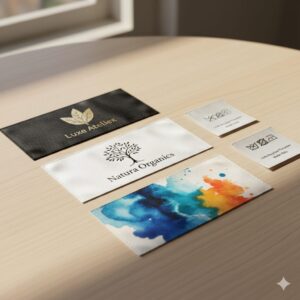
2. Experiment with Textures and Sustainable Substrates
Material science now enables a wide range of printed label substrates, each affecting drape, surface absorption, and tactile perception. Satin, edge-satin, and cotton-based printed labels behave differently under high-resolution printing.
For brands prioritizing eco-friendly manufacturing, integrating recycled or organic cotton substrates offers a measurable sustainability advantage. For more insights on material-driven decision-making, refer to The Environmental Benefits of Using Sustainable Label Materials.
3. Integrate Micro-Detail Artwork for High-Resolution Print
Printed labels can accommodate ultra-fine detailing, such as:
-
Micro linework
-
Subtle gradients
-
Fine typography
These design elements elevate perceived quality, especially when used for premium collections. They also serve as anti-counterfeit features when implemented strategically.
4. Use Structured Frames to Enhance Visual Hierarchy
Frames create a boundary that improves definition between the artwork and the stitching zone. A simple single-line frame increases contrast, reinforces brand identity, and enhances scanning readability in retail environments.
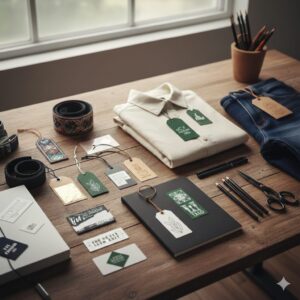
5. Combine Printed Labels with Woven or Cardboard Elements
Brands often benefit from hybrid label ecosystems—printed labels for internal care or neck branding, paired with woven labels for external identity tags or cardboard hang tags for retail presentation. Integrating multiple label types establishes a cohesive identity system.
To explore such multi-format strategies, see Woven Labels, Cardboard Labels & Printed Labels: Find the Perfect Match for Your Brand.
6. Apply Bold Color Blocking for Modern Branding
Strategic use of bold, high-saturation blocks can create distinctive visual anchors. When printed on satin or cotton grounds, these color fields maintain stability with minimal bleeding, provided the color calibration aligns with production constraints.
This method works especially well for lifestyle products, streetwear brands, and limited-edition runs.
7. Highlight Brand Storytelling Through Typography
Typography remains one of the strongest tools for communicating brand personality. Serif fonts convey heritage and craftsmanship; geometric sans serif fonts communicate modernity and minimalism. A well-structured typographic system ensures label scalability across multiple product formats.
For brands exploring deeper narrative approaches, The Art of Storytelling Through Product Labels provides extended guidance.
8. Enhance Functionality with QR Codes or Micro-Data Zones
Printed labels allow the integration of scannable components such as:
-
QR codes
-
Batch tracking data
-
Material traceability identifiers
These additions support compliance, supply chain transparency, and customer engagement—without compromising aesthetics.
9. Design for Seam Compatibility and Edge Behavior
Printed label substrates respond differently when stitched into garments. Satin edges fold smoothly, whereas cotton substrates may require additional margin allowances to prevent fraying. Edge behavior directly influences:
-
Label comfort
-
Stitch integrity
-
Long-term durability
LabelGo’s production workflow ensures the correct cutting methodology (heat cut, laser cut, or ultrasonic depending on the material) to maintain clean, professional edges.
10. Use AI-Assisted Prototyping for Precision and Speed
The rise of digital configurators and AI-driven tools accelerates concept validation while reducing error rates. These systems allow designers to test layouts, adjust colors, and preview label behavior before production begins.
For brands seeking greater efficiency, explore The Benefits of Digital Label Design and Customization Tools.
Conclusion
Creative printed label design relies on a precise combination of material knowledge, engineering discipline, and brand coherence. By applying the strategies above—minimalist layouts, material-led decisions, micro detailing, framing, hybrid label systems, and AI-assisted workflows—brands can achieve labels that not only look exceptional but also perform reliably through the entire product lifecycle.
LabelGo continues to support global brands with technical expertise, advanced production workflows, and industry-leading precision, ensuring every printed label reflects the highest standards of quality and branding integrity.