
In the global apparel market, size labels are not just informational elements—they are functional tools that directly affect customer satisfaction, return rates, and regulatory compliance. Brands selling across Europe, the United States, and the United Kingdom must understand that size standards vary significantly by region, and a one-size-fits-all approach creates confusion and mistrust.
This guide outlines the key differences between EU, US, and UK size labeling systems, explains best practices for international brands, and highlights how accurate size labeling supports brand credibility and long-term scalability.
Why Global Size Standards Matter
Incorrect or unclear size labels lead to:
-
Increased product returns
-
Poor customer reviews
-
Fit-related complaints
-
Reduced brand trust
Size labels serve as a decision-making reference at the point of purchase, especially in e-commerce where customers cannot physically try garments. Consistency and clarity are critical.
For brands building international collections, size labels must align with regional expectations, not internal assumptions.
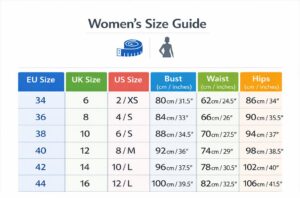
Overview of Size Labeling Systems
EU Size Standards
-
Numeric sizing (e.g. 34, 36, 38, 40)
-
Based largely on body measurements in centimeters
-
Common across continental Europe
-
Often paired with height or fit indicators for precision
EU sizes are perceived as technical and measurement-driven, making them suitable for brands focused on accuracy and fit transparency.
US Size Standards
-
Alpha sizing: XS, S, M, L, XL
-
Numeric sizing for women: 0–14+
-
No single governing body → brand-based interpretation
US sizing varies widely between brands. Clear size charts and consistent labeling are essential to reduce ambiguity.
UK Size Standards
-
Numeric sizing similar to US women’s sizing (e.g. 6, 8, 10, 12)
-
Historically distinct from EU sizing despite geographic proximity
UK customers expect explicit UK size references, even when EU equivalents are shown alongside.
Best Practice: Multi-Regional Size Labels
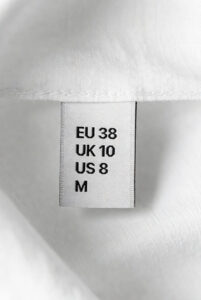
For international distribution, the most effective solution is combined size labeling, for example:
EU 38 / UK 10 / US M
This approach:
-
Reduces customer hesitation
-
Improves cross-border conversion rates
-
Minimizes size-related returns
Size labels should remain clean, legible, and proportionate to the garment. Overcrowding information reduces usability.
For a broader framework, see
A Guide to Standard Size Labels Across Global Markets

Size Labels and Brand Perception
Accurate sizing communicates professionalism. Inconsistent or misleading size labels signal poor quality control—even when the garment itself is well-made.
This is why size labels are a foundational component of brand systems, alongside main labels and care labels. When aligned correctly, they reinforce trust and repeat purchasing behavior.
Related reading:
Size Labels Helping Customers Find the Perfect Fit
What Are Size Labels and Why Are They Essential?
Integration with Care and Compliance Labels
Size labels are often sewn together with care labels. When exporting to the EU, UK, or US, brands must ensure:
-
Size information is not obscured by folds
-
Font size remains readable after washing
-
Materials withstand repeated laundering
For legal context, see:
What Are Care Labels and Why Are They Legally Required?
Production Considerations for Global Brands
From a manufacturing perspective:
-
Size labels must be consistent across batches
-
Reorders must match archived specifications
-
Placement and fold type should support fast sewing and comfort
Standardizing size label systems early allows brands to scale without operational friction.
Conclusion
Global size labeling is not about conversion tables alone—it is about customer clarity, compliance, and brand reliability. EU, US, and UK markets each follow distinct sizing conventions, and successful brands respect these differences rather than simplify them away.
Well-designed size labels help customers choose confidently, reduce returns, and position your brand as structured and trustworthy across international markets.
For brands planning long-term growth, accurate global size labeling is not optional—it is foundational.