
Clear and accurate size labels are essential for customer satisfaction, reduced returns, and brand credibility. In fashion and textile manufacturing, size labeling is not just a design element—it is a functional communication tool that directly affects fit perception, usability, and compliance across global markets.
This guide explains how to design size labels that are easy to read, technically correct, and scalable for long-term brand growth.

Why Size Label Accuracy Matters
Size labels help customers quickly identify the correct fit without confusion. Poorly designed or unclear size labels can lead to:
Incorrect garment selection
Increased returns and exchanges
Negative customer experience
Loss of trust in brand consistency
From a production standpoint, inaccurate size labeling also creates operational risks during cutting, sewing, and packing stages.
For a foundational overview, see:
What Are Size Labels and Why Are They Essential?
Follow Global Size Standards
One of the most common mistakes brands make is ignoring regional size conventions. A “Medium” in one market may not match another.
When designing size labels, consider:
EU, UK, US size differences
Numeric vs. letter sizing (e.g., 38 vs. M)
Dual-size systems for export markets
Brands selling internationally should reference standardized sizing systems to avoid confusion.
Related reading: Global Standards in Size Labels (EU, US, UK)

Choose the Right Size Label Format
The format of the size label affects both readability and durability.
Common size label formats include:
Woven size tabs (high durability)
Printed satin or taffeta labels (soft, cost-efficient)
Combined size + care labels (space-saving)
For garments with frequent washing, woven or high-quality printed labels are recommended to prevent fading or deformation.
If size information is combined with wash instructions, clarity becomes even more critical. See also:
Care (Wash Instruction) Labels: A Must for Every Garment
Typography and Readability
Legibility is non-negotiable. Size labels are often small, so font selection and contrast must be engineered carefully.
Best practices:
Use simple, sans-serif fonts
Avoid thin or decorative typefaces
Ensure strong contrast between text and background
Keep size text centered and isolated from other information
For woven labels, remember that very small text may lose clarity depending on loom density and thread selection.
Consistent Placement Across Products
Consistency builds trust. Size labels should always appear in the same location across a product line.
Typical placements include:
Inside neckline (tops, jackets)
Center back seam
Waistband (bottoms)
From a manufacturing perspective, consistent placement improves sewing speed and reduces production errors.
Avoid Overcrowding the Label
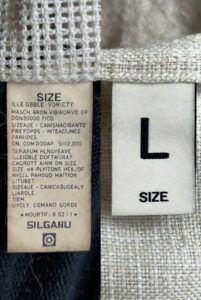
A size label should communicate one thing clearly: the size.
Avoid adding:
Logos
Slogans
Excessive decorative elements
If additional branding is required, it should be handled on a separate main label or hang tag. Overcrowding reduces readability and increases the risk of misinterpretation.
Test Before Mass Production
Before approving mass production:
Review the pre-production PDF carefully
Check size legibility at actual scale
Confirm size consistency across all variants (XS–XXL)
Once approved, production follows the confirmed specification. Design errors at this stage cannot be treated as manufacturing defects.
Long-Term Brand Consistency
Well-designed size labels support scalability. When your sizing system, typography, and placement are standardized, future collections become easier to manage and reproduce.
Size labels are small components, but they play a major role in how customers perceive quality, reliability, and professionalism.
Final Note
Clear and accurate size labels are not about aesthetics—they are about function, precision, and trust. A technically sound size label design reduces customer friction, supports international growth, and strengthens brand credibility over time.
For brands aiming for consistency across woven, printed, and care labels, size labeling should be treated as a core part of the overall labeling system—not an afterthought.